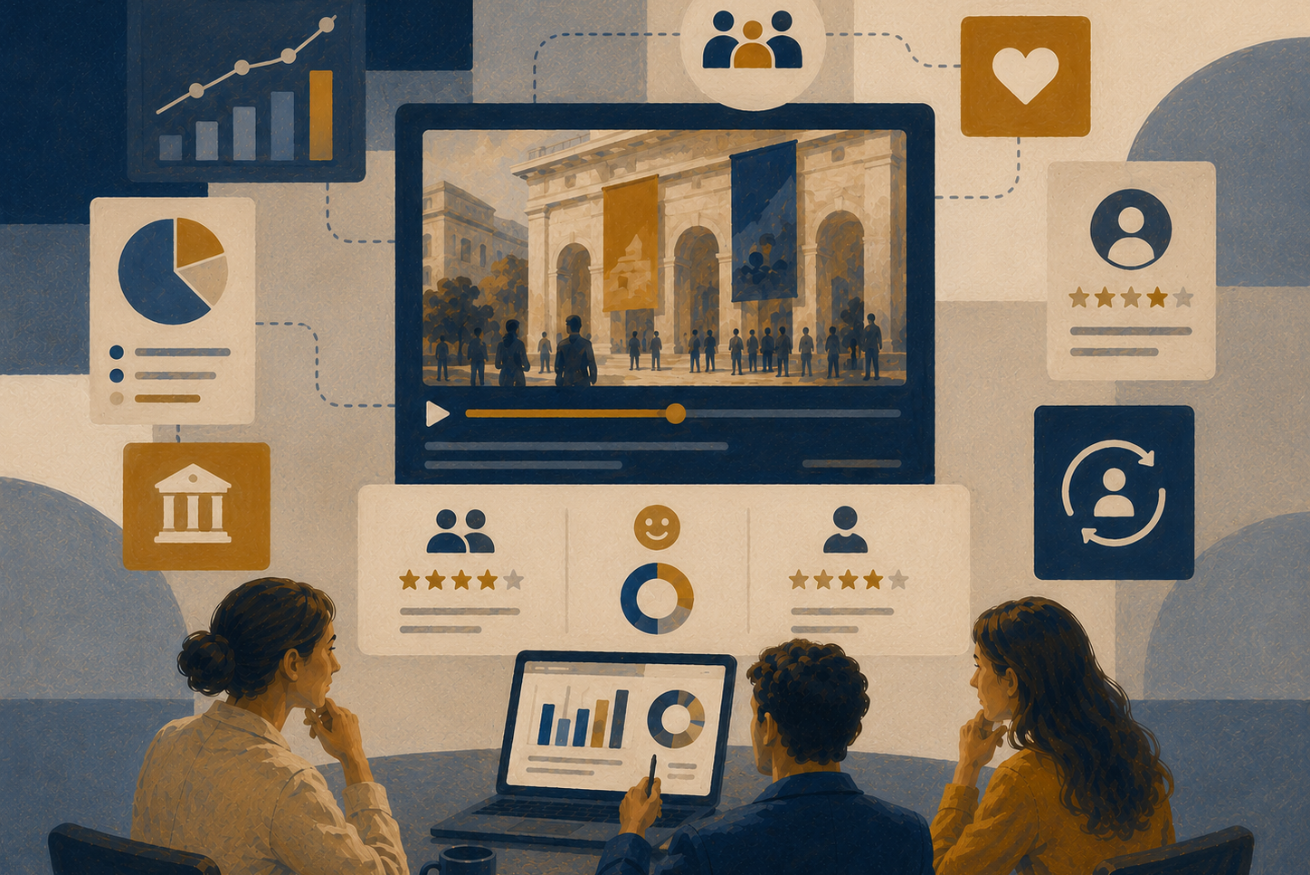
While cultural patronage can be a powerful driver of employee engagement, it is not automatic: it all depends on how it is activated.
In 2023, 118,000 companies reported €2.93 billion in donations according to Admical. Nearly 28% of these were in the cultural sector. At the same time, Gallup estimates that only 20% of employees worldwide reported being engaged in 2025, representing an estimated productivity loss of nearly $10 trillion.
These two dynamics currently shape executive decision-making: companies are investing in culture while seeking credible levers to strengthen employee engagement and talent retention. However, few have truly linked the two.
This guide provides a comprehensive analysis of the link between cultural patronage, employee experience, and internal performance. It is intended for HR directors, communications departments, CSR teams, and partnership managers looking to structure this lever methodically.
Employee engagement: a major economic and organizational challenge
Employee engagement directly influences performance (Harvard Business Review, 2017). Companies with high levels of engagement generally record better productivity and lower turnover. Gallup has been documenting these correlations for several years.
Hybrid work has made collective touchpoints more fragile:
- informal interactions are becoming rarer
- information flows are multiplying
- employees understand strategic directions without necessarily identifying with them
In this context, strengthening employee engagement requires working on the day-to-day experience. Purely informative initiatives are reaching their limits, and organizations are looking for mechanisms capable of fostering coherence and a sense of pride in belonging.
For a detailed analysis of the global employee engagement landscape in 2026, read our dedicated article.
Why culture taps into the deep drivers of engagement
Culture mobilizes powerful emotional and narrative mechanisms. According to the 2025 Havas Art & Culture Barometer:
- 92% of French people associate culture with psychological well-being
- 72% of employees want more cultural initiatives in the workplace (77% among 18- to 24-year-olds)
These figures reflect a defining generational expectation: young talent evaluates companies based on their coherence and cultural sensitivity. Credible cultural commitment helps strengthen employer branding.
Culture creates shared points of reference: a common work, a supported artist, or a regular program become landmarks that, over time, feed into our collective memory.
Employee engagement is fueled by these concrete elements, which are integrated into the internal experience.
Corporate cultural patronage: an existing asset
Cultural patronage is not uncharted territory: in sectors like finance, luxury, or professional services, for example, it already shapes the institutional narrative.
Annual reports highlight the amounts invested, the institutions supported, and partner exhibitions and concerts. These commitments contribute to external reputation and societal legitimacy.
Yet, 40% of companies that sponsor culture do not use their benefits, and only 26% fully leverage them, according to Admical (2024). This gap reveals an underutilized internal potential.
Why internal potential remains underutilized
Three factors frequently recur within organizations.
- The strategic narrative remains implicit: employees are aware of the partnership without always understanding its connection to the company's mission or strategy.
- Accessibility remains uneven: without context, some works can seem disconnected from operational roles. The distance is not cultural; it is pedagogical.
- An event-driven approach dominates: highlights create real but short-lived intensity. The lack of continuity prevents the development of a cohesive journey.
These obstacles do not stem from a lack of interest in culture, but rather reflect a lack of internal structure.
Transforming patronage into a structured employee experience
Effective activation relies on three complementary dimensions:
- context
- storytelling
- continuity
Context provides the keys to understanding. It explains why the company supports a specific institution and how this choice aligns with its strategy.
Storytelling connects cultural content to internal values. A company committed to education and legacy might highlight artists working on memory and heritage. An innovation-driven organization might promote contemporary creation.
Continuity structures the experience over time. Preparing for an event, supporting it, and then extending it with complementary content helps anchor the partnership in a sustainable dynamic.
The operational implementation of this transformation is detailed in our article on the employee experience.
The role of digital in scaling up
Digital tools make it possible to broaden access for all employees, including those in international or hybrid organizations:
- A cultural platform integrated into existing tools facilitates adoption
- Integration with the intranet or Microsoft 365 environments reduces friction
- Short, contextualized formats fit seamlessly into professional workflows
In programs deployed for major banks and an international luxury brand, 35,000 employees were engaged. Users viewed an average of four pages per session, with an average time of 4 minutes and 30 seconds per page. These figures show that a structured digital cultural experience can find its place in the professional daily routine.
Measuring impact to drive strategy
Where executive management expects precise indicators, measurement strengthens the credibility of cultural patronage.
Digital platforms like Vialma allow you to track the number of active users, return frequency, time spent, and the diversity of engaged profiles. This data makes internal adoption visible.
These should be supplemented by qualitative surveys:
- Do employees recognize the company's cultural commitments?
- Are they proud of it?
- Do they perceive a link to the organizational identity?
We analyze these indicators and their interpretation in detail in our article on impact measurement.
Articulating cultural patronage, CSR, and employer branding
Public cultural engagement influences a company's overall perception. Havas reports that 67% of French people say that cultural engagement increases their desire to consume a company's products or services. This figure reaches 83% among 18 to 24-year-olds.
When this engagement is experienced internally, it strengthens the employer brand: employees embody a consistent identity, and the alignment between external messaging and internal experience becomes tangible.
Governance and internal organization
Cultural activation involves several departments: HR, communications, CSR, and partnerships. Clear governance facilitates consistency.
Integrating impact measurement into the budget from the project's inception strengthens legitimacy, and regular reporting to executive management ensures long-term viability.
Cultural patronage thus becomes a managed lever, integrated into the employee engagement strategy.
Conclusion
Cultural patronage is a strategic asset already present in companies. Its impact on employee engagement depends on how it is structured.
Organizations that articulate activation, continuity, and management strengthen their internal consistency and their ability to retain talent.