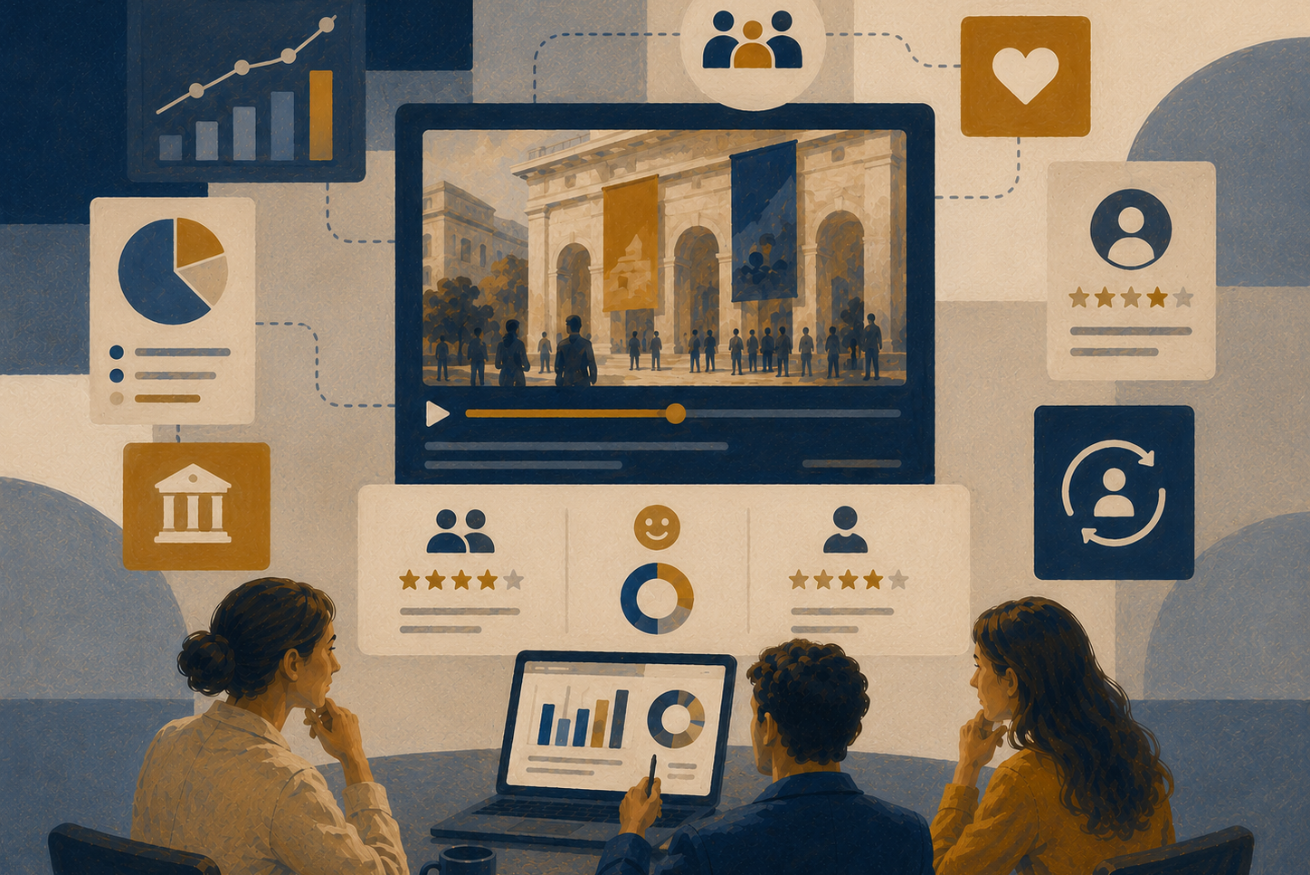
At a time when executive leadership demands precise metrics, measuring the impact of cultural patronage has become a strategic necessity. HR and communications departments must demonstrate the tangible contribution of their initiatives to employee engagement and talent retention.
Although patronage enjoys strong institutional recognition, its internal impact often remains intuitive, and this gray area weakens its legitimacy during budget reviews.
The most forward-thinking companies have begun integrating measurement from the very design phase of their cultural programs.
Why cultural patronage is vulnerable during budget reviews
According to the 2024 Admical Barometer, 74% of companies anticipated a stable patronage budget. However, stability does not mean an absence of pressure, as executive leadership compares cultural initiatives against other internal investments: HR digitalization, ESG programs, innovation, wellness initiatives, and more.
Initiatives with objective internal impact data are more resilient.
Cultural patronage has historically been evaluated through:
- the amounts invested
- external visibility
- the reputation of the supported institutions
These indicators do not address the core questions facing HR and Communications departments: does the program actually contribute to strengthening employee engagement? Is there a measurable effect on talent retention?
Moving from a declarative approach to a usage-based one
The transformation begins with a shift in perspective. It is no longer just about asserting that a cultural partnership strengthens cohesion. You must observe how employees interact with the program.
Digital cultural platforms like Vialma now make it possible to measure concrete behaviors.
Relevant indicators include:
- the number of active users over a given period
- the frequency of return
- the average time spent browsing
- number of page views
- audio or video streams longer than 30 seconds
- click-through rate on curated content paths
This data makes the relationship between employees and cultural content visible.
In the solutions deployed by Vialma for major banking groups and an international luxury brand, the observed results include:
- 35,000 engaged employees
- 100,000 page views
- 4 pages per session on average
- 4 minutes and 30 seconds average time per page
- 27,000 audio and video streams
- 67% of streams longer than 30 seconds
- 27% click-through rate
These indicators do not measure emotion, but they objectify usage and provide a basis for dialogue with executive management.
Measuring employee engagement through dynamics
Reducing cultural impact to a single figure would be simplistic; analysis must focus on trends:
- a steady increase in the number of active users indicates gradual adoption throughout the organization
- a high return frequency suggests that the platform is becoming part of daily routines
- a diversity of engaged profiles demonstrates cross-departmental adoption.
These dynamics help answer strategic questions:
- does the platform only reach employees who are already culturally engaged?
- Is there a balanced level of participation between support functions, technical roles, and management?
- Do key events generate a spike followed by sustained usage?
These elements help integrate cultural patronage into a genuine employee engagement strategy.
Cross-referencing quantitative data with qualitative perception
Digital metrics should be supplemented by qualitative data, and internal surveys can include targeted questions:
- Do you clearly identify the company's cultural commitments?
- Are you proud that your company supports these institutions?
- Do you perceive a link between these commitments and the organization's identity?
Cross-referencing observed usage with stated perception strengthens the robustness of the analysis.
An employee who regularly views cultural content and expresses a sense of pride provides a convergent signal, and this convergence reinforces the credibility of the initiative.
Integrate measurement from the project design phase
Lancelot Lefebvre, Deputy General Delegate at Fondation Engie, emphasizes the importance of integrating evaluation from the moment a project is formed. This approach avoids relying solely on self-reported data and helps structure a credible case.
Define in advance:
- employee engagement objectives
- usage metrics to track
- correlation points with internal surveys
- reporting frequency
This foresight facilitates dialogue with executive management and secures long-term budget stability.
Measure to manage, not to manipulate
Culture retains an irreducible qualitative dimension. The goal of measurement is to observe engagement, not to reduce the artistic experience to a set of metrics.
Measurement allows you to:
- identify the most engaging formats
- adjust curated content journeys
- improve accessibility
- optimize integration with internal tools
It strengthens the strategic credibility of cultural patronage within the company.
Towards fully data-driven cultural patronage
When usage is observed, analyzed, and shared internally, cultural patronage changes status: it becomes a lever integrated into employee engagement strategy and employer branding.
This evolution requires:
- an adapted digital architecture
- structured editorial expertise
- clear governance between HR, communications, and partnerships
- regular reporting to executive management
For a comprehensive strategic overview that combines implementation and management, see our comprehensive guide to cultural sponsorship and employee engagement.
Conclusion
Measuring the impact of cultural patronage is no longer optional: leadership must demonstrate the real contribution of their initiatives to employee engagement and talent retention.
- Digital tools now make it possible to observe concrete usage
- Internal surveys complement this perspective
- The synergy between quantitative data and qualitative perception strengthens the credibility of the program
Companies that adopt this management approach transform their cultural patronage into a sustainable strategic lever.