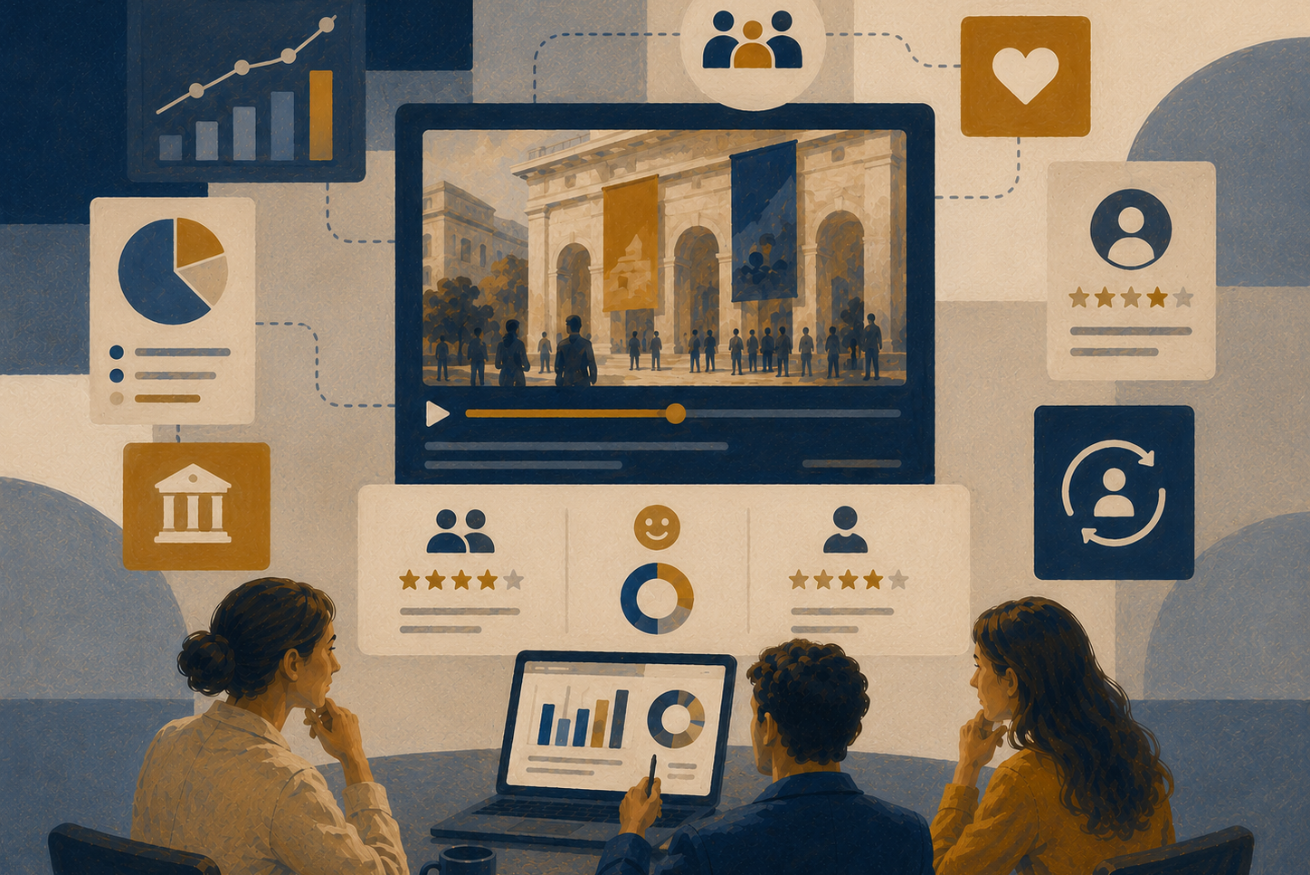
Transforming cultural patronage into an employee experience requires a precise framework: the partnership already exists in most large companies, so the challenge lies in its internal activation.
Organizations that structure this activation observe three measurable effects:
- better ownership of commitments
- strengthened consistency between employer brand and lived reality,
- long-term growth in employee engagement.
The operational question is simple: how can you organize this transformation without complicating your internal ecosystem?
Why internal communication is no longer enough to create an employee experience
Internal communication initiatives have historically relied on disseminating information: intranets, newsletters, executive committee videos, and internal campaigns. While these tools structure strategic alignment, they rarely create a memorable experience.
In a hybrid environment, employees receive dozens of messages every week. The problem:
- Information overload reduces attention
- Understanding a message does not guarantee retention or ownership
Studies published in the Harvard Business Review show that organizations that leverage emotional drivers in their employee experience achieve better results in terms of retention and collective performance.
Culture can contribute to this experiential depth if it is structured.
Employee experience and cultural patronage: scaling up
A cultural partnership generates relational and institutional value. To become a driver of employee experience, it must circulate throughout the organization.
Three structural conditions enable this scaling.
1. Context
Employees must understand why their company supports a specific institution.
Briefly introduce:
- the institution's mission
- its territorial or societal impact
- the connection to the company's values or strategy
This contextualization bridges the gap. It transforms institutional information into a strategic benchmark.
2. Storytelling
Linking cultural partnerships to internal themes creates coherence. Whether it's innovation, knowledge transfer, excellence, diversity, or creativity, storytelling connects content and weaves it into a global narrative.
A bank supporting an orchestra can, for example, highlight the concepts of coordination and collective listening. A luxury brand can emphasize the passing down of artistic expertise in alignment with its own crafts.
3. Continuity
A one-off event generates a spike in attention. A regular program builds familiarity.
By structuring the experience into three phases, the company embeds cultural patronage over the long term and strengthens employee engagement:
- before: prepare and contextualize
- during: support and connect to internal goals
- after: extend and deepen
These findings are part of the broader analysis of employee engagement challenges developed in our previous article: Employee engagement and cultural patronage
The structural role of digital in the employee experience
Digital tools expand access and extend the experience beyond physical events.
An effective internal cultural platform relies on three operational pillars:
- content contextualization
- editorializing into coherent journeys
- integration with existing tools
Technical integration is a real challenge: a standalone solution that isn't connected to an intranet or environments like Microsoft 365 or Slack creates friction and limits adoption.
Companies that achieve significant results ensure they:
- limit new logins and passwords
- integrate content into existing workflows
- offer short formats tailored to professional habits
In the programs deployed by Vialma for two major French banks and an international luxury brand, this approach engaged 35,000 employees, or approximately 35% of the target base. Users viewed an average of 4 pages per session, with an average time of 4 minutes and 30 seconds per page.
These data points illustrate that a structured digital cultural experience can find its place in daily routines.
Establishing cultural rituals without increasing the internal workload
The employee experience is built on consistency: cultural rituals work when they are simple and recognizable.
Here are a few examples observed in large organizations:
- a weekly musical selection linked to an internal theme
- a monthly spotlight on a supported institution
- an editorial journey before and after a major event
- short formats providing insights that can be read in under three minutes
These formats do not replace existing initiatives but rather establish a rhythm.
Consistency creates a touchpoint, the touchpoint fosters familiarity, and familiarity facilitates adoption.
Alignment between employer branding and internal experience
67% of French people state that a company's public cultural commitment increases their desire to consume its products or services. This figure reaches 83% among 18- to 24-year-olds, according to Havas Art & Culture 2025.
This external perception directly influences the employer brand.
When a company supports prestigious cultural institutions, its employees should be able to experience that commitment firsthand. Aligning external image with internal experience strengthens credibility.
In sectors where brand identity relies heavily on culture, this consistency becomes strategic. Luxury houses provide a clear illustration of this; while artistic partnerships shape their external narrative, internal activation reinforces a sense of pride and belonging.
Structuring a manageable employee experience
Transforming cultural patronage into an employee experience requires planning for measurement.
Relevant metrics include:
- the number of active users
- the frequency of return
- the average time spent browsing
- the diversity of engaged profiles
This data allows for tracking the progress of employee engagement within the framework of the cultural program.
We set out these indicators and how to interpret them in our article on measuring the impact of cultural patronage on employee engagement.
Towards a cultural architecture integrated into the employee experience
Companies already possess significant cultural capital. The transformation lies in integrating it into the overall architecture of the employee experience.
This integration requires:
- a clarified strategic intent
- consistent editorial curation
- temporal continuity
- usage measurement
When articulated together, these elements transform cultural patronage into a structural lever for internal engagement.
To explore this approach in greater depth and gain a comprehensive strategic overview, please see our comprehensive guide to cultural sponsorship and employee engagement.
Conclusion
Transforming cultural patronage into an employee experience requires precise structuring. Companies that succeed in this transformation align strategy, editorialization, and management.
Cultural activation thus becomes an operational lever for driving employee engagement, strengthening your employer brand, and retaining top talent.